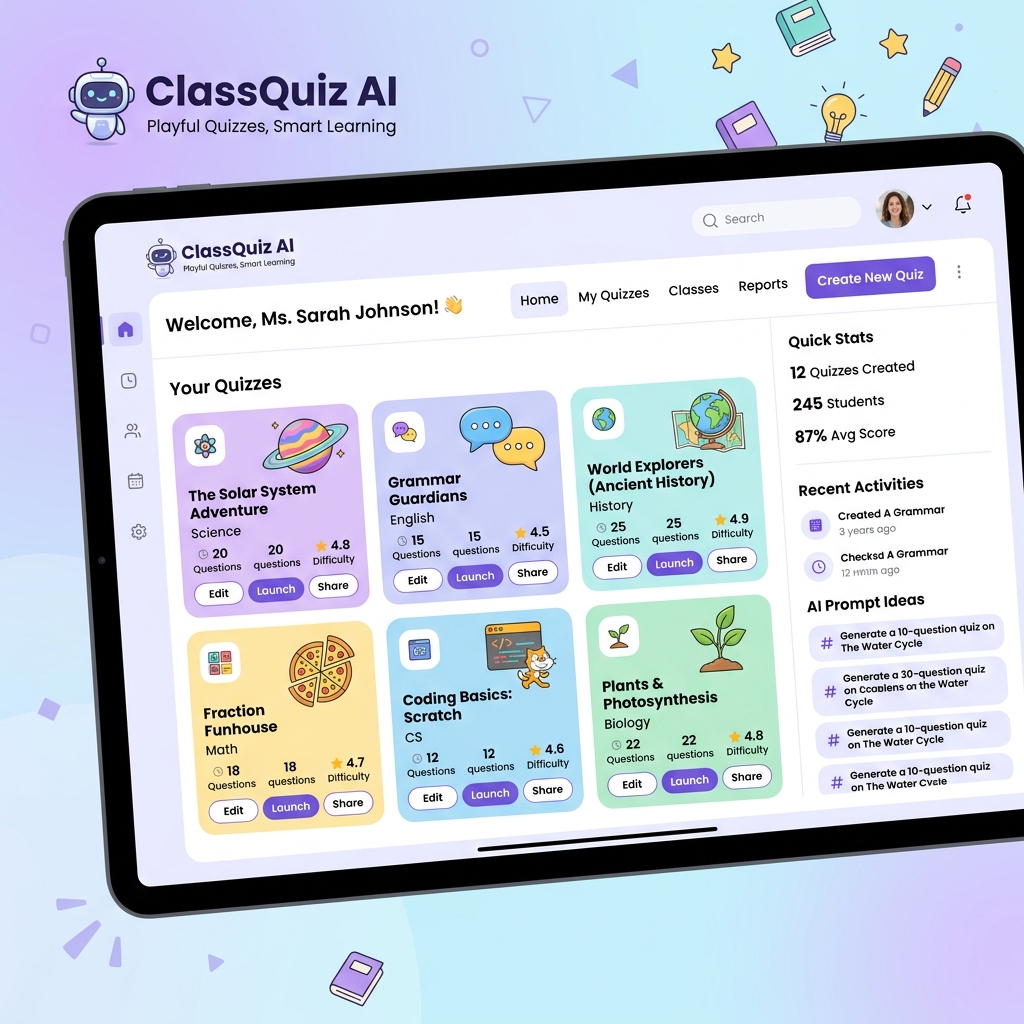
Background & Failure
An educator created an AI-powered quiz generation tool. It worked brilliantly on demo content, but completely collapsed in a live classroom environment.
- Generative Errors: Duplicate questions and unrelated answers.
- Matchmaking Overload: Live quizzes crashed with just 30 students.
- Data inconsistency: The no-code database handed out duplicate quiz IDs.
"Classroom apps must work perfectly on test day. Teachers don't have time to manually patch AI errors."
Solution Steps
Backend Scaling
Migrated storage from a no-code spreadsheet to a SQL database ensuring unique IDs and transactional integrity.
Data Validation
Added input sanitization so the AI only generates from vetted content, severely reducing nonsense answers.
Concurrency Management
Implemented a simple load balancer preventing server crashes when large classes of 30+ students log in simultaneously.
Monitoring
Deployed usage analytics to catch generation errors in real-time, allowing teachers to report and us to fix rapidly.
Outcomes & Metrics
90%+
Quiz Accuracy (Up from ~60%)
100+
Requests / Minute Handled
4x
Fewer Errors Reported
The app is now fully ready for widespread school pilots without fear of crashing during class time.
Rescue Timeline
Technical Deep Dive
Building an AI quiz generator for a classroom requires absolute predictability. The primary issue with this edtech MVP fix was that the LLM was left unconstrained, which led to hallucinated answers and duplicated choices.
To resolve this, we implemented strict JSON schema enforcement on the OpenAI API calls. By forcing the model to return structured data rather than free-form text, we eliminated parsing errors. We also introduced a semantic similarity checker to ensure the AI never generated four multiple-choice options that were functionally identical, a common flaw in early teacher-built apps.
JSON Schema Enforcement
Guarantees structured quiz output, preventing frontend crashes from malformed strings.
Semantic Deduplication
Automatically rejects and regenerates answers that are too similar, maintaining quiz integrity.
Executive Summary for EdTech Founders
In the classroom, technology must simply work. If your Rescue Leap education software crashes when 30 students log in simultaneously, the teacher will never use it again. Scaling an EdTech application isn't just about server capacity; it's about bulletproof data validation.
When you transition from a prototype to a production-ready application, you must replace "hope-driven" prompt engineering with strict programmatic safeguards. We specialize in fortifying these systems so educators can trust your software to run their classrooms flawlessly.