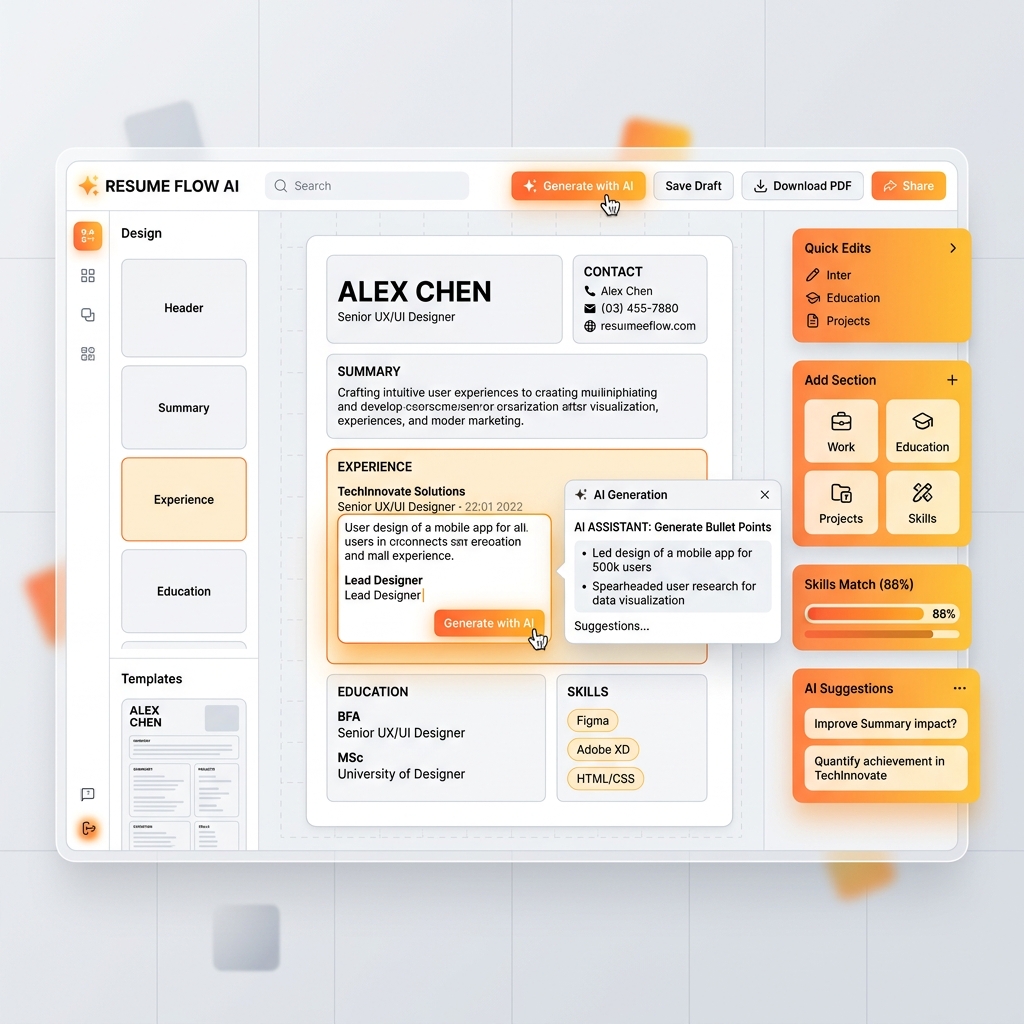
Startup & Problem
A career coach used GPT via a no-code builder to auto-generate customized CVs. Upon releasing to real users, templates broke, API hit rate-limits causing timeouts, and the backend completely slowed down under multiple users. Resume downloads failed 30% of the time.
Rescue Solution
Audit & Authentication
Fixed improper API quotas, added retries, and cached recent prompts. User inputs were strictly sanitized.
Backend Stabilization
Migrated core logic to Node.js Lambda functions with robust queuing logic, showing users progress bars instead of timeouts.
Template Fixes
Updated broken resume layouts and added real-time logging to catch content generation errors.
Deployment Hardening
Scaled the database to cache identical generated resumes optimally, decreasing response time drastically.
The Impact
>95%
Success Rate
-60%
Page Load Time
50+
Concurrent Users
0
Timeouts
Technical Deep Dive
Many founders mistakenly believe that connecting an LLM to a frontend form creates an AI resume builder. However, as this HR SaaS fix demonstrated, generating a massive block of formatted text takes time—often longer than typical HTTP timeout limits.
When five concurrent users hit the "Generate" button, the server blocked on waiting for the OpenAI API to return responses. By the time the LLM finished processing, the users' browsers had already timed out, leading to zero output and complete database gridlock.
Event-Driven Architecture
We moved the AI generation process to an asynchronous worker queue. Users now instantly receive a polling ID, preventing browser connection timeouts.
Intelligent Caching
We implemented Redis to cache exact prompt matches. If two users request a "Software Engineer template with Python," the system serves it instantly without calling the LLM.
Key Takeaways for SaaS Founders
A successful no-code MVP rescue isn't about entirely abandoning no-code tools; it's about knowing where they fail. No-code platforms are excellent for validating a UI, but they break under the prolonged, intensive compute requirements of generative AI.
If your startup revolves around content generation, long-polling and asynchronous processing are mandatory. The team at Logic Leap rebuilt this backend so the founder could focus on marketing their product instead of manually apologizing for broken downloads.